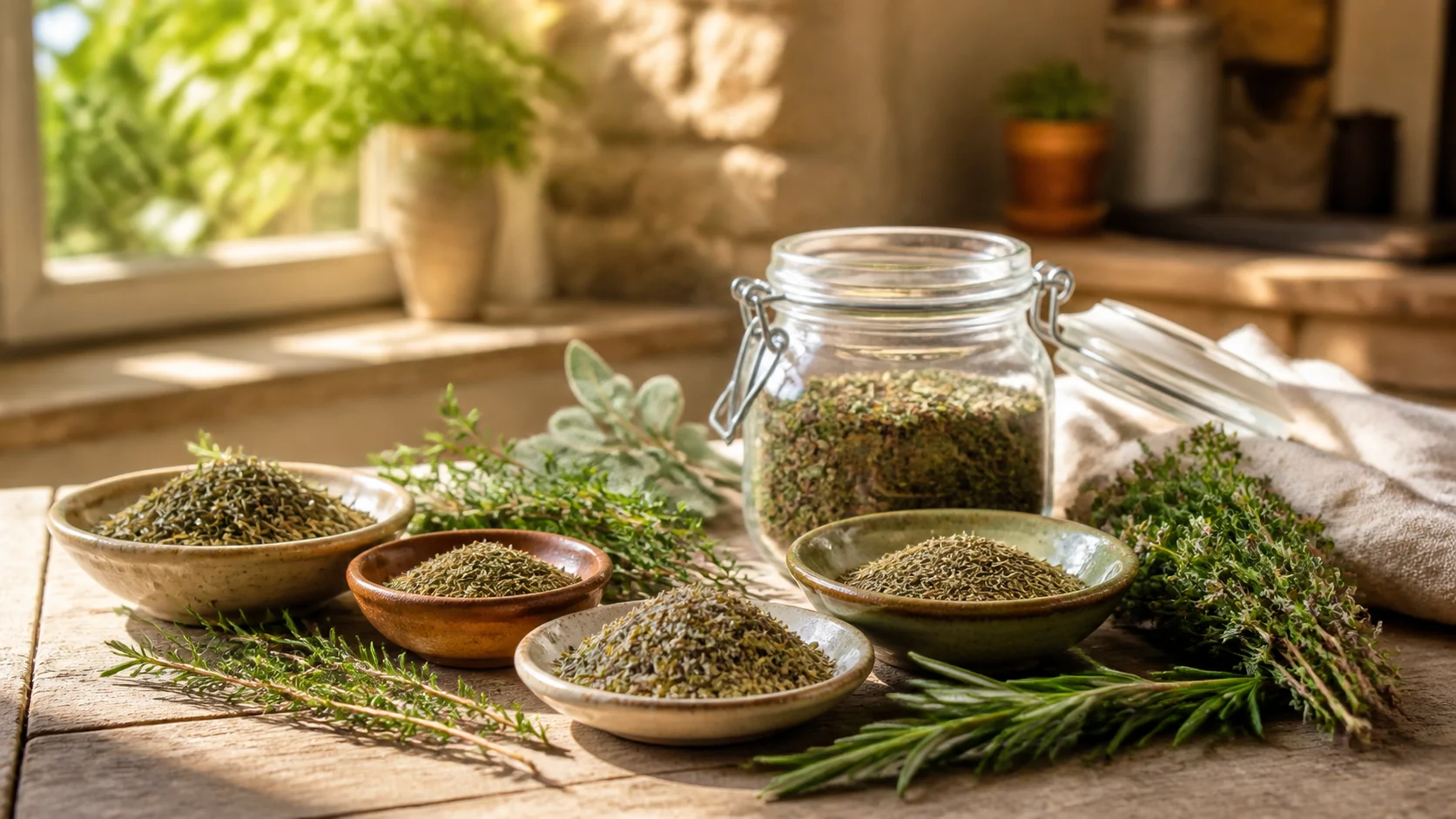
Opening a jar of herbes de Provence means in a few seconds you're in search of the scent of a warm path: crushed thyme, resinous rosemary, round oregano and peppery savory. Yet not all blends tell the same story. The quality depends on the plants chosen, their drying, their freshness and above all their balance. This guide allows you to create a precise homemade mixture, modify it according to the dish and really preserve its aroma.
- Herbs of Provence
- Thyme
- Rosemary
- Oregano
- Savory
- Drying
- Dosage
- Mediterranean cuisine
More than a recipe: a landscape put in a jar
The name evokes Provence, but the principle belongs to the entire Mediterranean: preserving aromatic plants from the dry season in order to prolong their presence in the kitchen. In the limestone hills, the wind, the sun and the poor soils concentrate the perfumes. At home, the mixture becomes a practical memory of the garden, the market or the trip.
There is no single family formula. Some houses favor thyme, others rosemary or oregano. In France, however, a Label Rouge specification governs a reference composition combining rosemary, savory, oregano and thyme. A personal blend can be a departure from this: the important thing is to know why each herb is there, rather than accumulating ingredients at random.
Understand the role of each plant
Thyme, the framework
Dry, floral and slightly camphorous, it gives the main line. It supports long cooking, tomatoes, legumes and simmered meats.
Rosemary, the accent
Powerful, resinous and lemony, it structures potatoes, grilled meats and breads. Too abundant or too finely ground, it quickly dominates.
Oregano, roundness
Warm, sweet and slightly peppery, it combines the flavors of tomato, olive and cheese. It gives the mixture its immediately Mediterranean character.
Savory, the finish
More lively, it brings a very useful peppery note to beans, chickpeas, eggplants and meats. It avoids too careful mixing.
Basil, in measure
Its dry scent is more discreet than that of fresh leaves. A small amount rounds out the mixture, without being essential.
Lavender, not automatic
It is not an obligation. Even culinary, it quickly becomes soapy. Reserve a few flowers for a specific variation rather than the daily jar.
The homemade formula that remains balanced
For a jar of approximately 60 g, mix 3 parts thyme, 2 parts oregano, 2 parts rosemary and 1 part savory. A “part” can be a spoon or a small glass: the ratio counts more than the unit. Crumble only the long rosemary needles between your fingers. The leaves should be of a similar size, without becoming a powder.
| Grass | Starting quantity | Function | To be reduced if… |
|---|---|---|---|
| Thyme | 3 spoons | Structure and length in the mouth | the mixture seems too dry or medicinal |
| Oregano | 2 spoons | Heat and roundness | you especially cook delicate fish |
| Rosemary | 2 spoons | Resinous freshness | its needles hide the other plants |
| Savory | 1 spoon | Peppery relief | the final dish becomes too fiery |
Before filling the jar, rub a pinch between your palms. The thyme should appear, then the rosemary, with a rounder and peppery finish. Correct by half spoonful. This olfactory tasting is more reliable than a copied formula without taking into account the real potency of your herbs.
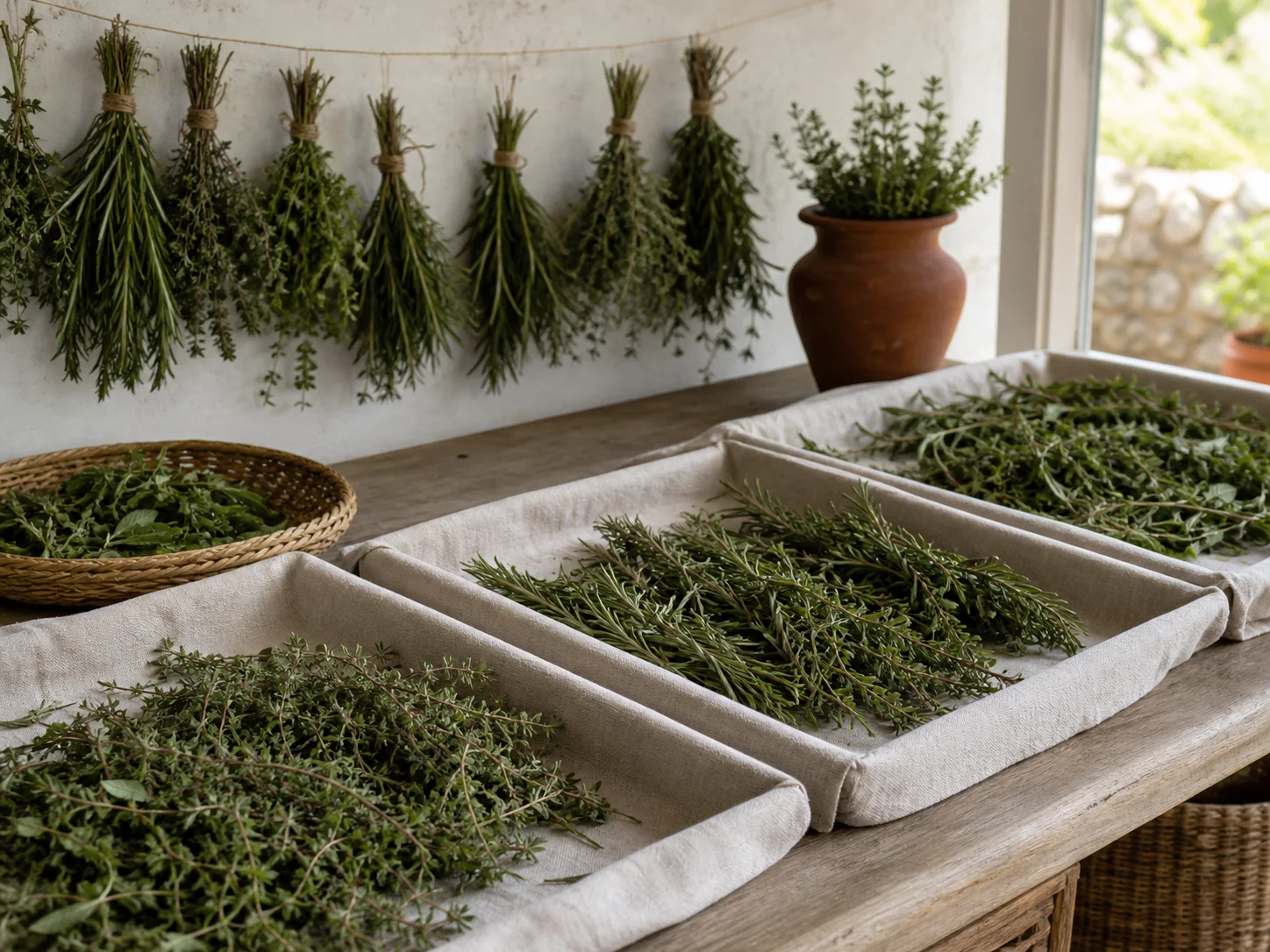
Dry herbs without erasing their scent
Harvest after the dew has disappeared, in dry weather, before the midday sun strongly heats the leaves. Discard stained or damaged stems. If washing is necessary, rinse very briefly then dry thoroughly: trapping water in a clump encourages browning and mold.
- Form small bouquets. Thick bundles retain moisture. You can also spread the stems in a single layer on a rack.
- Choose shade and ventilation.A dry, ventilated room protects colors and aromas better than a window in direct sunlight.
- Wait for the clean break. A ready leaf breaks away and cracks between the fingers; a still flexible stem contains moisture.
- Prune gently.Remove the thick stems and keep the leaves whole until blending to limit aromatic loss.
- Check before closing. No damp smell, no condensation and no soft leaves should remain in the jar.
Six variations designed for real dishes
More oregano, thyme, little rosemary. Add a pinch after cooking to find a fresh note.
Strengthen rosemary and savory, then add some crushed fennel seeds just before use.
Dominant thyme, discreet rosemary and untreated dried lemon zest. Avoid overly fragrant flowers.
Basic formula with a touch of marjoram. Mix the herbs with the oil before coating the vegetables.
Savory and thyme more present, with a touch of cumin added to the dish rather than to the main jar.
Reduce the rosemary by half and complete with marjoram for the eggs, fresh cheeses and zucchini.
The right time to add them
In a sauce, soup or stew, dry herbs benefit from being introduced early: they hydrate and diffuse gradually. For baked vegetables, mix them first with the oil to distribute the aromas and prevent the small leaves from burning alone on the plate. On a pizza, place the majority under the topping and save a pinch for when it comes out of the oven.
A short marinade requires ten to fifteen minutes of rest. For very lively cooking on the barbecue, avoid the thick layer of herbs directly on the flame: it darkens before the food is cooked. Instead, use a scented oil, then finish with a small, freshly crumpled amount.
Preserve, date and avoid false good gestures
- Choose a small airtight jar rather than a large, half-empty container.
- Keep it away from steam: shaking the jar over a saucepan allows moisture and heat to enter.
- Write the date of mixing and prepare only three to six months of consumption.
- Never use a wet spoon and close immediately after dosing.
- Do not reduce everything to powder: the exposed surface increases and the perfume disappears more quickly.
Frequently asked questions
Do Provence herbs have to come from Provence?
The common name of a mixture does not alone guarantee the origin of the plants. For a framed origin or quality, read the label precisely and look for an official sign accompanied by its specifications.
Can we use fresh herbs in the same dosage?
No. Fresh herbs contain a lot of water and vary in potency. Instead, use them as a separate bouquet, then adjust to taste.
Why does my mixture become bitter in the oven?
The temperature was probably too high, the leaves too thin or insufficiently coated. Mix them with the oil and keep some for last.
Should we add salt to the jar?
It is not necessary. A salt-free mixture remains more versatile and allows each dish to be seasoned independently.
Sources and benchmarks
Culinary guide updated in August 2026. The homemade proportions proposed here are voluntarily adaptable and do not claim official certification.