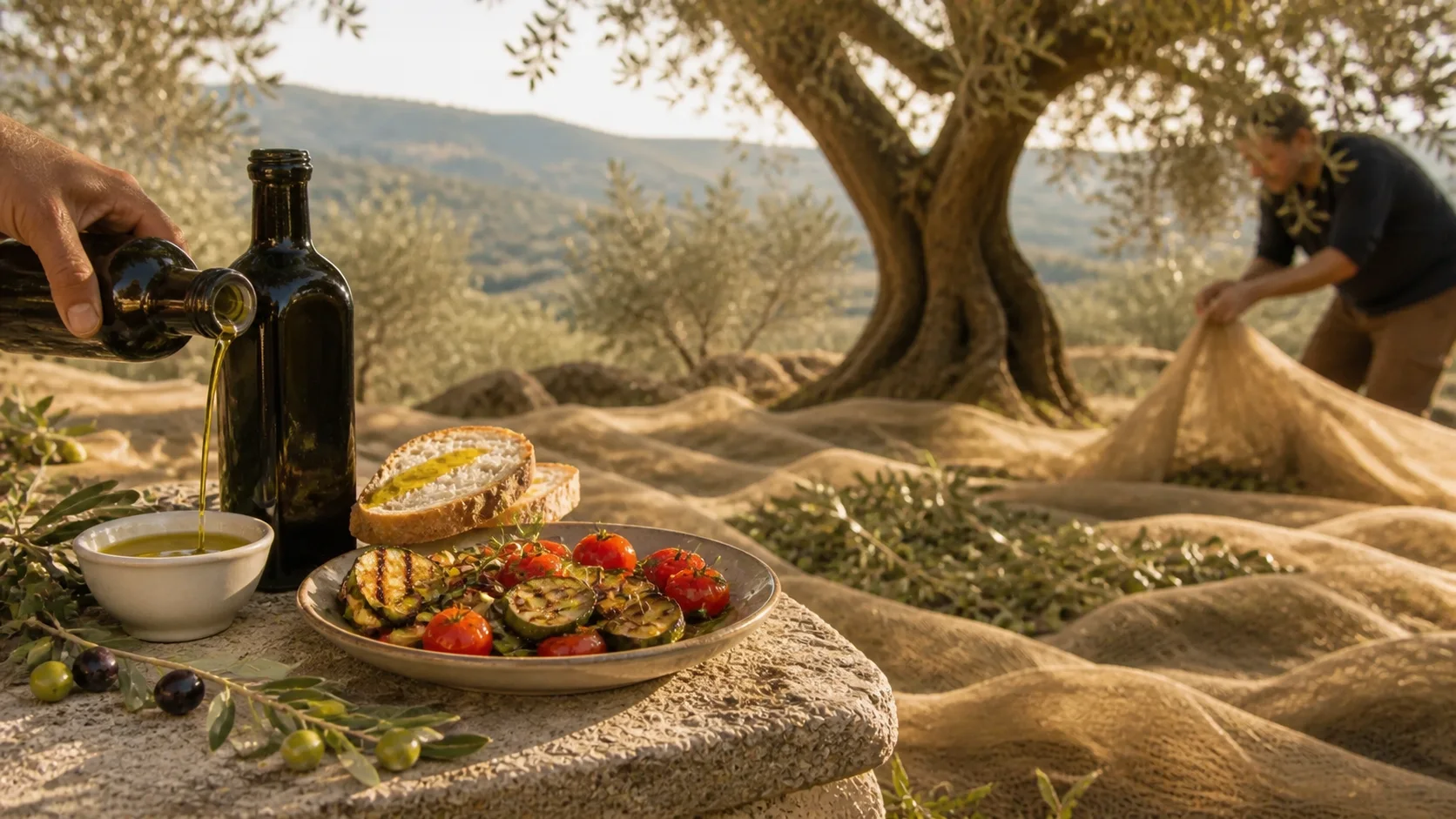
Olive oil is at the same time a fruit juice, an agricultural gesture and a memory of the Mediterranean basin. However, its quality cannot be reduced to its color, nor to a country, nor to the price of the bottle. It comes from a variety, a terroir, a harvest date, a mill and a conservation. Here are the concrete points of reference for understanding it, tasting it and using it without being misled by preconceived ideas.
- Olive oil
- Extra virgin
- Oil mill
- Cold extraction
- Green fruit
- Ripe fruit
- Taste and cooking
- Mediterranean basin
The olive tree, six millennia of living history
The cultivated olive tree, Olea europaea, descends from wild populations often called oleasters. Genetic work locates a major center of domestication in the Levant around 6,000 years ago, then shows a much richer history than a straight line progression: cultivated trees traveled with human societies and regularly crossed with local wild olive trees. This is how the same species produced an extraordinary mosaic of varieties from the Eastern Mediterranean to the Maghreb, then to the Iberian Peninsula.
Phoenicians, Greeks, Romans, Amazigh, Arab and Andalusian communities perfected grafting, pruning, presses, jars and uses. The oil illuminated homes and sanctuaries, preserved food, nourished bodies, perfumed preparations and was used to make ointments or soap. This historical depth explains the strength of its symbol: peace, longevity, fertility and continuity.
UNESCO does not reduce the Mediterranean diet to a list of foods. She describes it as a set of know-how, harvests, transformations, shared meals and transmissions. Olive oil occupies a central place with cereals, fruits, vegetables, legumes and herbs. Heritage is as much in the product as in the way of producing and sharing it.
The Mediterranean remains the heart, but the olive tree has traveled
Dry summers, abundant light and fairly mild winters shape its historic landscape. Large orchards can now be found in other regions with a Mediterranean climate: California, Chile, Argentina, South Africa and Australia. The terroir changes, but the freshness of the fruit and the precision of the mill remain decisive.
A single olive tree, hundreds of personalities
Talking about “types of trees” mainly means talking about cultivars, that is to say varieties selected and multiplied for their adaptation to a soil, a climate and a use. Some give mainly oil, others table olives, still others are mixed. The age of the tree or the beauty of a gnarled trunk do not alone guarantee superior oil: the health of the fruit, its maturity, the time before crushing and the work of the mill weigh more.
Algeria and Maghreb
Chemlal, a large olive variety from Kabylia, can produce sweet to fruity oils. The Sigoise, emblematic of Western Algeria, is dual-use. In Tunisia, Chemlali and Chetoui illustrate two very different profiles, from flexible to powerful.
Mediterranean Europe
Picual is often structured and fiery; Arbequina more rounded and delicate. Koroneiki can be herbaceous and lively. Frantoio, Leccino, Coratina or Picholine cover a wide range of bitterness and fruitiness.
Variety, terroir, harvest
The same cultivar does not taste exactly the same everywhere. Soil, altitude, water, climate, maturity and extraction modulate the profile. A well-constructed assemblage can be as noble as a single-varietal oil.
The orchards themselves differ. The traditional olive grove, often rainfed, space of large trees sometimes associated with other crops. Intensive plantations close the rows and facilitate mechanization. super-intensive hedgerow systems speed up harvest, but are only suitable for certain varieties and raise other questions about landscape, water, biodiversity and the lifespan of plantations. No model is enough to predict the taste of a bottle: you have to look at the entire chain.
From fruit to the mill: how is olive oil made?
A virgin oil is obtained only by mechanical or physical processes. There are no solvents or refining in extra virgin oil. Modern mills have replaced hydraulic pressure with centrifugation, which is more continuous and more hygienic, but the objective remains the same: to release the microdrops of oil contained in the cells of the fruit, then separate them from the water and solid materials without altering the aromas.
What exactly is an oil mill?
An oil mill — also called an oil mill — is the workshop where olives are received, weighed, sorted then transformed into oil. It is neither a simple store nor a refinery. A modern oil mill combines a reception area, a washer, a crusher, mixers, a centrifugal decanter, a separator, possibly a filter, then stainless steel tanks. It must also organize the traceability of each batch and the cleaning of the line: an impeccable fruit can lose its quality in dirty equipment or in contact with an old fermented batch.
- Harvest at the right time. An olive that is still green often offers less yield but more herbaceous aromas, bitterness and spiciness. A riper olive generally produces a softer, rounder oil. Fruits that have fallen to the ground or are damaged promote defects.
- Transport quickly and without crushing. Openwork crates are better than packed bags. Heat, fermentation and waiting are the enemies. Demanding producers often grind the same day.
- Clear the leaves, sort and wash. Leaves, wood, stones and defective fruits are removed before crushing.
- Crush the whole olive. Traditional stone millstones or metal grinders transform pulp, skin and pit into paste.
- Knead the dough. Slow stirring allows the microdroplets to come together. Time, temperature and exposure to oxygen must be controlled to preserve volatile and phenolic compounds.
- Separate by centrifugation. The decanter separates the oil from the vegetable water and the pomace; a vertical separator then refines the clarification.
- Filter and store properly. Filtration removes water and particles likely to ferment. The oil then rests in stainless steel tanks, protected from air, light and heat, sometimes under inert gas.
Pressure, centrifugation, saponification: let's not mix the words.
The European mention “first cold pressing” is reserved for virgin oils obtained under 27 °C with a traditional hydraulic press system. “Cold extract” concerns in particular centrifugation under 27 °C. Saponification is the reaction which transforms a fat with a base to make soap: it is not a step in the production of edible oil. Sulfurization is also not part of the normal process for virgin oil.
Quality is measured in hours, then in degrees
Between harvest and vat, every wait counts. A clean mill, controlled mixing and rapid separation protect the aromas of the fruit. “Cold Extract” describes the temperature of the process; it is not, in itself, a sensory classification.
Extra virgin, virgin, refined: what the categories really mean
The official classification combines chemical analyzes and a sensory evaluation carried out by a trained panel. Color does not enter into the classification: the official tasting glasses are even colored so that the taster is not influenced. A very green oil is therefore not automatically better.
How does an oil officially become “extra virgin”?
The producer cannot decide this just because the olives were cold pressed. The category is assigned to a lot of oil which must pass two families of controls. The laboratory analysis checks in particular the free acidity, the peroxide index, the ultraviolet absorbance and other markers of quality or authenticity. Then, a trained sensory panel looks for fruitiness and measures any defects. For the extra virgin category, the median defects must be zero, the fruitiness greater than zero and the free acidity must not exceed 0.8%; other regulatory limits must also be respected.
Controlled harvest, rapid crushing, no solvent extraction and no refining.
Acidity ≤ 0.8%, oxidation and other parameters within category limits.
Perceptible fruitiness and median of defects equal to zero.
Can we detect a real extra virgin at home?
We can identify the freshness, the fruity and certain defects, but we cannot certify the category without recognized analyzes and panels. The refrigerator test, the green color, or a very pungent sensation alone prove nothing. To buy with greater confidence, look for a traceable lot, a recent harvest, a precise origin, a protective container and, where available, a credible control or label.
| Category | Obtaining and criteria | To remember in cooking |
|---|---|---|
| Extra virgin olive oil | Mechanical processes only; no sensory defect, perceptible fruitiness, free acidity equal to at most 0.8 g per 100 g, plus other regulatory criteria. | The most aromatic choice, both raw and in controlled cooking. |
| Virgin olive oil | Mechanical processes; slight defects are allowed; free acidity at most equal to 2 g per 100 g in the European standard. | Edible as is, often less expressive or less clear. |
| Lampante oil | Virgin oil with defects or parameters incompatible with direct consumption. | It must be refined before entering into a marketed oil. |
| Olive oil | Mixture of refined olive oil and virgin olive oils suitable for consumption. | More neutral taste; do not confuse her with an extra virgin. |
| Olive pomace oil | From the solid residue of extraction, then refined and assembled according to its category. | Different product, clearly indicated on the label. |
Regulatory acidity measures free fatty acids in the laboratory. It provides information on the condition of the fruit and the control of the process, but it does not correspond to an acidic sensation in the mouth. You can't tell by tasting it. A very low value is interesting, without being in itself a certificate of excellence: an oil must also be fresh, clean and sensorially balanced.
Fruity, bitter, spicy: learning the language of oil
The three positive attributes recognized are fruity, bitter and spicy. The fruitiness is reminiscent of fresh olive and can evoke cut grass, tomato leaf, artichoke, apple, almond, banana or ripe fruit. Bitterness is felt on the tongue; the spiciness, sometimes peppery, develops in the throat. These two sensations are often linked to phenolic compounds and are not defects.
Green fruit
Olives harvested rather early: grass, leaf, artichoke, green tomato, fresh almond. Profile often more bitter and ardent.
Ripe fruitiness
More advanced olives: ripe apple, banana, dried fruits, floral notes. Generally softer and rounder profile.
Defects to recognize
Rancid (nutty or aged wax), winey-vinegary, moldy-damp, fermented or “unused”. An intact cap does not correct oxidized oil.
A simple tasting at home
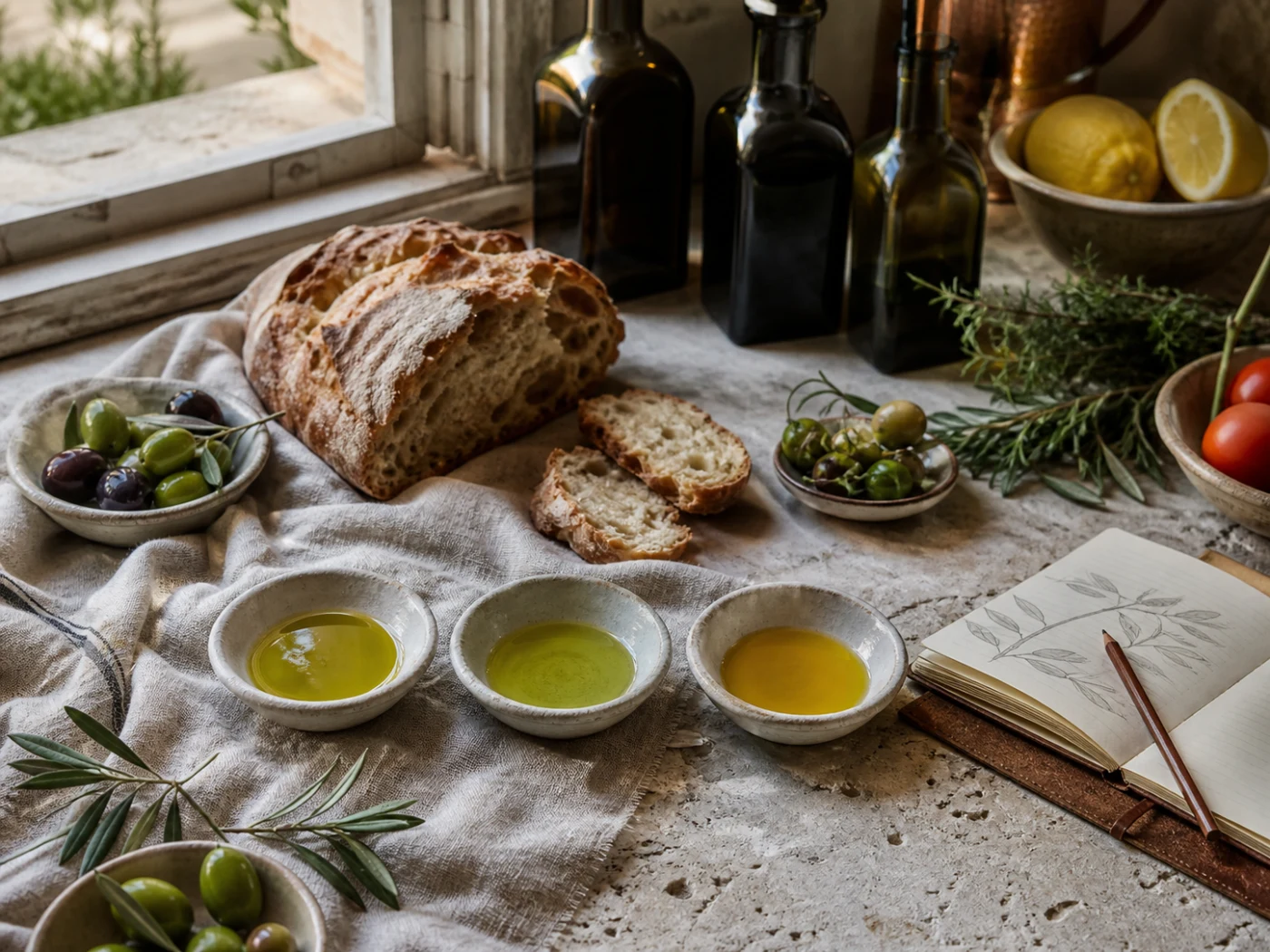
Pour a spoonful of oil into a small glass. Cover it with one hand and gently warm the base with the other. Smell, take a small sip, spread it in your mouth then suck a little air between your teeth. First note the aromas, then the bitterness, finally the spiciness. Tasting on bread is nice, but the bread masks some of the profile; to compare several oils, glass is more precise.
How to choose the right olive oil in store
There is no such thing as a universal “best oil”. There is a fresh oil, suitable and suitable for the dish. The price may reflect a demanding harvest or a small production, but it is not a substitute for verifiable information.
- Start with the category: explicitly search for “extra virgin olive oil” if you want maximum aromatic expression.
- Prefer a recent harvest date when indicated. A minimum durability date does not say when the olives were picked.
- Read the origin precisely: country of harvest and place of extraction are more informative than the address of the packer. An AOP or IGP links the product to specifications, without guaranteeing that you will like each profile.
- Choose a dark or opaque container: dark glass, metal or bag-in-box protect better from light. Prefer a small size if you consume little.
- Don't judge by the color: from golden yellow to intense green, it depends in particular on the variety and maturity.
- Beware of vague words: “light” often describes taste, not calories; all oils are energy fats.
- Taste if possible: look for clean fruitiness and no rancid smell. Moderate bitterness or spiciness can be very good signs.
Keep the bottle after opening
The four enemies are light, heat, oxygen and time. Keep the bottle tightly closed in a cool cupboard, away from the oven and a window. No need to refrigerate it: the cold can cloud or freeze it temporarily without constituting a test of authenticity. Buy a quantity that you will use in a few weeks or months rather than a large container that will remain half empty all year round.
Raw, in the oven or in the pan: which oil for which use?
An extra fresh virgin is suitable for salad dressings, marinades, pestos, hummus, soups, fish, roasted vegetables and everyday cooking. Its richness in mono-unsaturated oleic acid and the presence of antioxidants give it good stability in reasonable domestic conditions. As with any fat, avoid letting it smoke, overheating it for a long time or reusing it many times.
| Profile | Natural pairings | Simple idea |
|---|---|---|
| Sweet, almond, apple | White fish, mayonnaise, pastry, delicate vegetables. | Replace part of the butter in a lemon cake. |
| Herbaceous, balanced | Tomato, zucchini, chickpeas, pasta, eggs, poultry. | Finish a shakchouka or vegetable soup. |
| Intense, bitter, peppery | Grilled meat, lentils, beans, bitter vegetables, rustic bread. | Pour a few drops over hot potatoes. |
For the finish, choose the oil like a spice: a delicate oil respects a fish or a dessert; fiery oil revives soup, meat or grilled vegetables. For long cooking, a less expensive but fresh and clean oil is often more rational than a microcuvée whose volatile aromas will partly disappear.
Health and care products: real benefits, promises to be qualified
Olive oil is mainly composed of lipids and provides as much energy as other oils. Its benefit appears especially when it replaces fats rich in saturated fatty acids and is part of a diet rich in vegetables, fruits, legumes, whole grains, nuts and fish. The PREDIMED trial observed fewer major cardiovascular events in high-risk people following a Mediterranean diet enriched with extra virgin olive oil or nuts, compared to the recommended low-fat control diet. This result concerns a complete food model, not a “miracle” spoon.
Extra virgin oils also contain phenolic compounds. In the European Union, the claim that the polyphenols in olive oil contribute to protecting blood lipids against oxidative stress is only permitted if the oil provides at least 5 mg of hydroxytyrosol and its derivatives per 20 g of oil. Not all bottles reach this threshold and an oil does not replace treatment or medical advice.
And on the skin or hair?
Olive oil and its derivatives are used in soaps, balms, hair oils and emulsions. In a cosmetic formula, they can contribute to the touch, emollience and the oily phase. This does not mean that pure edible oil is suitable for all skin types. Studies have reported that repeated application could alter the skin barrier in certain people, particularly on atopic skin, while clinical evidence for treating lesions remains limited.
The good skincare reflex: prefer a product formulated and tested for its use, do a test on a small area and stop in case of irritation. On an infant, eczematous, acne-prone, damaged or allergic skin, seek advice from a healthcare professional rather than directly applying cooking oil.
Frequently asked questions
Is very green oil better?
No. Color varies with variety, maturity, filtration and storage. The essential criteria are category, freshness, aromatic clarity and absence of defects.
Is the deposit at the bottom of the bottle a sign of quality?
Not necessarily. Unfiltered oil may contain particles and residual water. It can be excellent very fresh, but these residues often reduce its stability; consume it quickly.
Can you cook with extra virgin oil?
Yes, for most domestic cooking. Just avoid smoke, very long heating times and repeated reuse. Keep a particularly fine oil for finishing if you want to preserve its full bouquet.
Does “First press” mean better quality?
No. This is a technical term reserved for the traditional press process. Excellent modern oil is usually extracted by centrifugation. Extra virgin category and freshness are more helpful for choosing.
Should you buy a single-varietal oil?
Not necessarily. It helps discover the character of a cultivar, but a blend can offer more balance and consistency. The know-how of the producer counts more than the number of varieties.
Sources and benchmarks
- International Olive Council — designations and definitions of olive oils.
- International Olive Council — global statistics and forecasts 2025/2026.
- Delegated Regulation (EU) 2022/2104 — categories, labeling and cold notices.
- UNESCO — the Mediterranean diet, intangible cultural heritage.
- Proceedings of the Royal Society B — complex history and domestication of the olive tree.
- UC Davis — modern olive oil processing line and protection through packaging.
- New England Journal of Medicine — PREDIMED trial and cardiovascular prevention.
- PubMed — review of topical uses of olive and limits of evidence.
Informational article updated in August 2026. Campaign standards and data may change; the official links above allow you to consult their most recent version.